Monday, October 14, 2024

Feed Back from the Southern Cape: Mission - Expedition 72 - ARISS Series 21 SSTV Experiment

The official portrait of the International Space Station's Expedition 72 crew. At the top (from left) are, Roscosmos cosmonaut and Flight Engineer Alexey Ovchinin, NASA astronaut and space station Commander Suni Williams, and NASA astronaut and Flight Engineer Butch Wilmore. In the middle row are, Roscosmos cosmonaut and Flight Engineer Ivan Vagner and NASA astronaut and Flight Engineer Don Pettit. In the bottom row are, Roscosmos cosmonaut and Flight Engineer Aleksandr Gorbunov and NASA astronaut and Flight Engineer Nick Hague. Credit: NASA/Bill Stafford and Robert Markowitz

The recent ARISS Slow Scan Television (SSTV) experiment from the International Space Station took place from Tuesday, October 8, at 16:00 GMT and run until Monday, October 14, at 14:10 GMT.  Great interest was shown in the experiment by radio amateurs in the Southern Cape Area, Bloemfontein and Orania, with several participating in the project.

What did the Experiment entail?

"The SSTV transmissions will be made using the amateur radio station in the ISS Service Module. The transmission frequency will be 145.800 MHz (+/- 3.5 kHz Doppler shift) FM, using SSTV mode PD120.

Many FM rigs can be switched been wide and narrow deviation FM filters. For best results you should select the filter for wider deviation FM. Handhelds generally have a single wide filter fitted as standard.

The ISS call-sign will be RS0ISS.

Reports are requested: please send ARISS uploading your decoded pictures in the official ARISS SSTV gallery: https://www.spaceflightsoftware.com/ARISS_SSTV/

Useful information to receive the pictures can be found here: https://amsat-uk.org/beginners/iss-sstv/

Follow ARISS on X for official updates during the event https://x.com/ARISS_Intl  "

ED - Congratulations to Gerrit ZS1KLO, Rulhof ZS4RM and Zayn ZR3VO in receiving your ARISS SSTV Award.  Well done!!


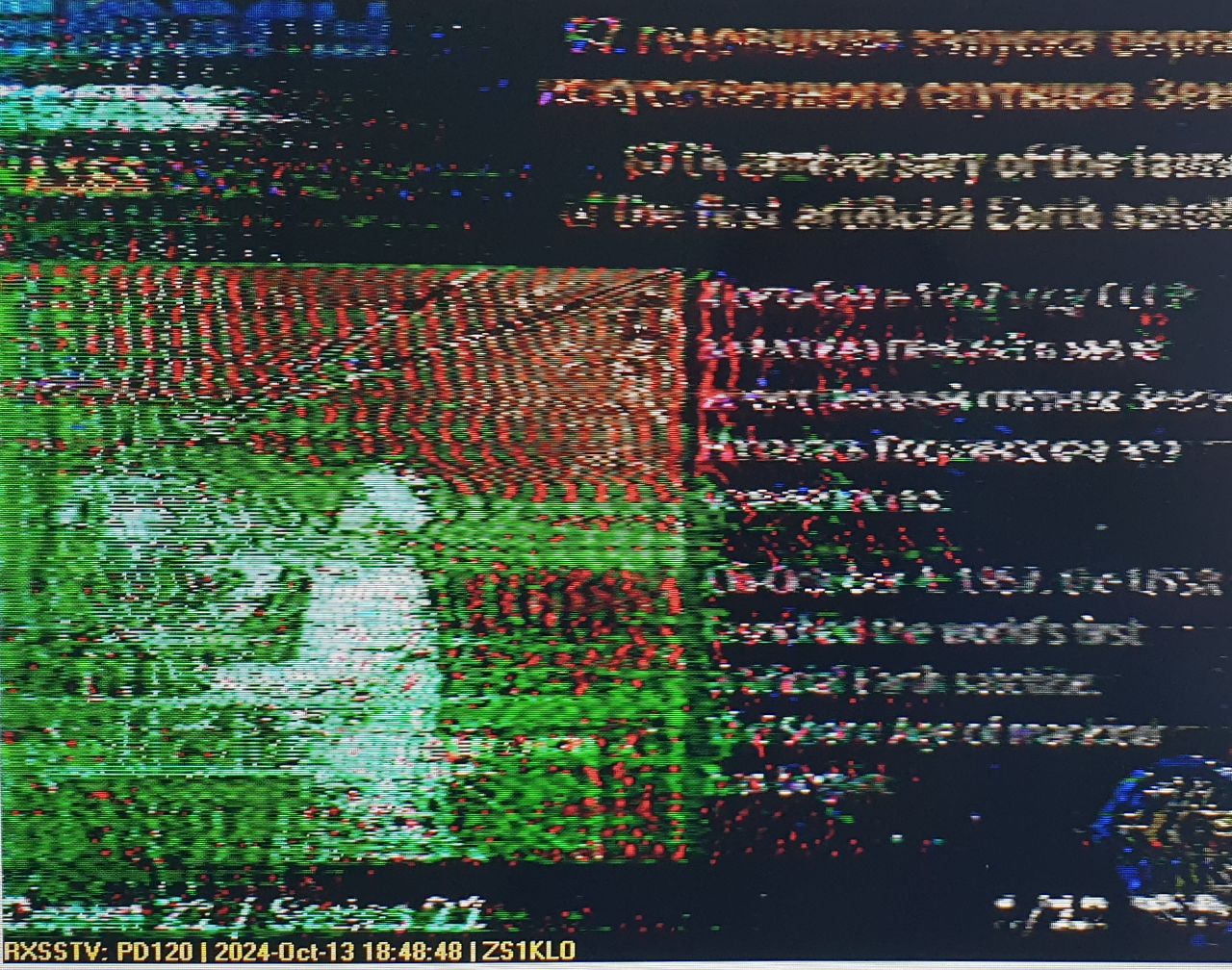
Herewith some images (Click to enlarge) of the radio amateurs that participated in the ARISS SSTV Experiment:

Gerrit ZS1KLO  Rheebok, Mosselbaai:


Johan ZS1I Heiderand, Mossel Bay:

I used this ARISS SSTV Event to experiment with Doppler Shift, 2 element Quad Antenna, Nagoya NA-771 Whip Antenna, 1/4 Wave Ground Plane Antenna, Robot36 Software, GPredict and Baofeng UV82 HT.  I tried to use the same or similar pass predictions, Az and El for each antenna in KF15bt.  Unfortunately the weather was different every time I downloaded an image.  None the less a very interesting experiment.


Rulhof ZS4RM,  Bloemfontein:


Thys ZS1TBP Heiderand, Mossel Bay:


Zayn ZR3VO,  Orania:


Tweet by ARISS - Amateur Radio on the ISS:  @ARISS_Intl

Suggestion by ZS1I:

Great PR project for ARISS, Ham Radio and New Radio Amateurs. New interest in space coms in S/Africa. Suggestion: Shorter gaps between TX would be great. Thanks for making this project available.

Wednesday, October 9, 2024

New Series - Building Low Budget Antennas - "1/4 Wave Ground Plane Antenna for 2 Meters - Project 6


I continue with the series "Building Low Budget Antennas" for Radio Amateurs. Nothing fancy or with high gain.... no just simple low budget antennas!

In this article I will be looking into building a 1/4 Wave Ground Plane Antenna for 2 Meters. Now I know there are thousands of ways to construct this antenna, but how cheap can you build one? R10, R20 or R50. You decide how much such an antenna will cost.

General Specifications:

Resonant Frequency: 145.550 Mhz

Frequency Span: 145.000 - 145.800 Mhz

Modes: FM ( Local repeaters and simplex)

Polarity: Vertical (Note: Repeaters use vertical polarization.)

Antenna Impedance: 50 Ohm or very close to 50 Ohm

Gain: Approximately 2 - 3 dBd

I found a very useful quarter wave calculator if you want to change the measurements to suite your needs. This calculator is used to determine the length of each element of the antenna. That includes the vertical monopole radiating element and the 4 radials.

The calculator is available HERE

Enough said let's start building the 1/4 Wave Antenna.

Materials I used:

3d Printed Ground Plane Support Parts (3 items) Available HERE (Note you do not need these parts. I will explain later how to build the antenna without these parts.)

1 x PL239 Socket Connector (Not ideal rather use BNC or N-Type Connectors but I used what I had on hand)

1 x 1 meter 25mm Electrical Conduit pipe

1 x brass 5A Electrical Connector Block ("Chocolate" Block)

1 x 1.5 Meter (2.5 mm) Copper Wire (Ideal would be brazing rod but I used what I had on hand. Brazing rod is far sturdier but more expensive.)

Odds and Sods:

Cable Ties

Silicon Sealant

Insulation Tape

Solder

Solder Paste

5 -10 m Coax Cable (RG58CU Mil Spec) 50 ohm with 2 x Connectors (Feeding line to radio)

Self Amalgamating Electrical Tape

Tools:

Hack Saw or PVC Pipe Cutter

Soldering Iron

Sharp Utility Knife

Screw Driver (Small flat)

Test Equipment:

VHF SWR Meter

Antenna Analyzer (If you have one but not compulsory)

VHF/UHF Radio

Coax Patch Leads

Mast (Non conductive)

Power Supply or Battery for Radio

Building the Antenna:

I am not going to go into detail how I constructed my version of the antenna as there is more than enough info via the links and images how to construct this antenna. A word on the 3d Printed parts. You can use the SO239 without the 3D printed parts. Just fit the bottom threaded part of the SO239 and the PL259 in the one end of the 25mm electrical conduit pipe. To make it fit tightly you can use self amalgamating tape around the connectors and then push it into the pipe. Hot-glue can also be used to hold the connectors tight in the pipe. Improvise is the answer here. You can also make an aluminum L bracket and secure the SO239 to the bracket.

Testing the Antenna:

I ran a quick test on the antenna with my HT just to see what the SWR was like. Well the images speak for themself. SWR was 1: 1 between 145.000 - 145.800 Mhz. With the antenna just above the roof, I can work the 145.750 Mhz Aasvoelkop- and all the other repeaters in the area. I did some more tests with the VNA Antenna Analyzer. See the images below.

Side Notes:

I found that the antenna works just as well on 70 cm's. SWR 1.2:1 on 70cm. Unfortunately I did not do any measurements with the VNA on 70 cm's .

Conclusion:

This antenna will be good to download SSTV images from the ISS. It is lightweight and easy to setup/install. To the new radio amateurs this antenna is an ideal first time antenna project.

I am very happy with the performance of this 1/4 wave antenna on 2m and 70 cm's. Well worth spending my time on building this antenna.

Final cost to build this antenna: R45.00 ($2.5 US)

Images: Click on images for larger view.


Monday, October 7, 2024

What's in the Box?


Here is another "What's in the Box?"

Contents:
   

1.  Raspberry Pi 5 Power Supply

2.  HDMI Cable or Raspberry Pi 5

3.  Raspberry Pi 5 (4GB RAM)

4.  Raspberry Pi 5 Active Cooler

What do I have in mind for the above items?

Will be used to control, monitor and switch the ZS HUB Network in Mossel Bay.  I will post a article on how I plan to "control" all the systems via this little marvel computer.

Images:  Click on the images for large view.


Friday, October 4, 2024

Mark ZS4OIL donate radio to be used on the ZS Link Hub Network in Mossel Bay!


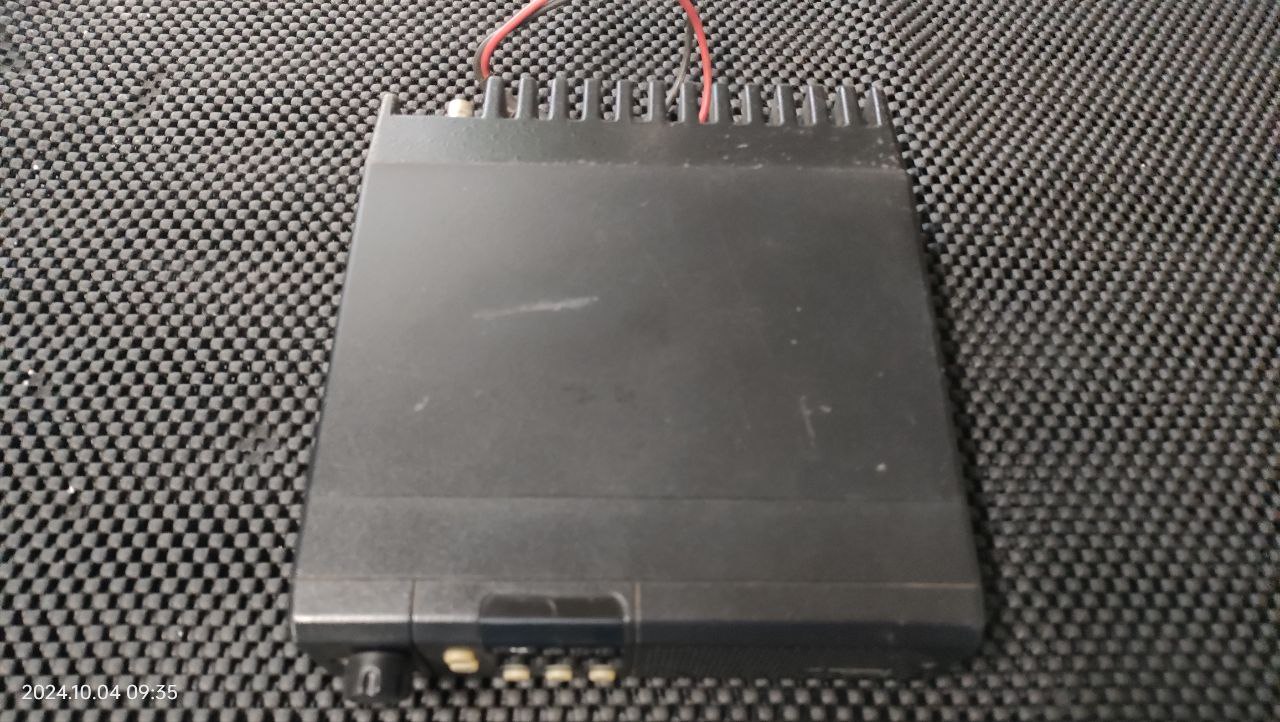
Now here is a story of  real amateur radio spirit and no Mark ZS4OIL does not know that I am writing an article about his kindness.  In today's life things are rather tough also when it comes to amateur radio.  There is a song with the name of Money, Money, Money which reminds me that nothing comes for free anymore.  I was however proven wrong.  Some time ago I was looking for a UHF Motorola Radio to be used with a SVXLink node.  I put out a request for such a radio and Mark ZS4OIL responded that he has such a radio.  I was unsuccessful in all my efforts to buy the radio from him.  He refused to accept anything even the costs to send the radio to me.  Mark donated a UHF Motorola GM300 radio  to me.   I received the radio this morning.  This radio will be used as a link radio for the ZS1I SVXLink Reflector that is currently connected via VHF to the ZS Link Network here in the Southern Cape.

Mark I would like to thank you for your generosity, great amateur radio spirit and for donating this radio, to be used to extend the ZS Link Network in the Southern Cape.  Highly appreciated and once again a big thank you!!

I will later post images where this radio is connected to the network and operational.

Images (Click on images for larger view.)


Closure of this ZS Link Network Blog - 29 April 2026

This will be the final posting on the ZS Link Network Blog. This blog will no longer be updated but will remain available for research an...